Public Education Programs

Our goal is to educate people of all ages on the dangers of fire, provide information to prevent them, and, in the unfortunate instance a fire occurs, provide the tools to ensure safe evacuation.


Fire safety tips

Visit these pages to learn more about smoke and carbon monoxide alarms:

A fire can double in size every minute! It is so important that everyone knows what to do and where to go when the smoke alarm sounds.

Create a fire escape plan

Learn more about creating a home fire escape plan and drawing a floor plan using an escape plan template.

Be prepared, get out and stay out

  1. Know your floor plan: Refer to your Fire Escape Plan and practice it twice a year, once during daylight and once at night. Practice different ways out
  2. Know how to exit:
    • The first way out is to use the door. The second way out is to use a window if the room has one. If you see smoke on your way out the door, use the window. If there is no window or other exit, crawl on your hands and knees keeping your head 12-24 inches (30-60 cm) above the floor and move under the smoke.
    • If you live in an apartment building, use the stairs to escape. Do not use the elevator. It might not work or stop on a floor where the fire is still burning.
  3. If fire or smoke is blocking your exit:
    • Close all doors between you and the fire. If you live in an apartment, close your main door, but don’t lock it.
    • Cover all cracks where smoke can enter with towels or blankets
    • Wait at a window and signal for help with a light-coloured towel or flashlight to help firefighters locate you
    • If you can access a phone, call 9-1-1 even if firefighters are already outside. Tell the operator where you are.
    • Stay calm and listen for instructions from fire personnel
  4. Know where to meet outside: This could be a neighbour's home or a familiar landmark nearby, like a tree, a streetlight or a sign
  5. Stay out: Do not go back for any reason, and do not try to rescue possessions or pets. If people are trapped, firefighters have the best chance of rescuing them.

Lithium-ion batteries supply power to many kinds of devices, including smartphones, laptops, e-scooters and e-bikes, e-cigarettes, smoke alarms, toys, and even cars. If not used correctly or if damaged, these batteries can catch on fire or explode.

To learn more, check the lithium-ion battery safety infographic.

Cooking left unattended is a leading cause of home fires in Ontario.

Learn how you can prevent cooking fires.

Smoking is the #1 cause of fatal home fires in Ontario.

Learn how you can prevent a smoking fire.

When to use a fire extinguisher

Fire extinguishers are designed to contain or put out a small fire until the Fire Department can arrive. They are not intended for use on large or spreading fires.

Before you fight any fire, make sure that:

  • You know how to use the fire extinguisher
  • Everyone else has left the building, and someone is calling 9-1-1
  • The room is not full of smoke, and you have a clear escape route – never let the fire get between you and the exit
  • You have the correct type of extinguisher for the type of fire that is burning

How to use a fire extinguisher

Learn how to use it before a fire happens. Read the instructions that come with it. Most fire extinguishers empty within 30 seconds.  If the fire is not out by then, get out!

Remember the word PASS:

-  Pull the pin. Hold the nozzle pointing away from you and release the locking mechanism.
A -  Aim low at the base of the fire
S -  Squeeze the lever or button above the handle to discharge the extinguishing agent slowly and evenly
S -  Sweep the nozzle or hose from side to side

Types of extinguishers

Consider using an extinguisher with an ABC rating because it can be used on most types of household fires. Look for the Underwriters’ Laboratories of Canada (ULC) label on the extinguisher, which means it was tested.

Extinguishers are labelled with symbols or letters for the classes of fire they can put out. Classes are based on the types of combustible materials in a room.

Placement of fire extinguishers

Where to place a fire extinguisher

  • On every level of the home, near bedrooms, in the kitchen, in the garage
  • Mounted at least four inches off the ground and no higher than five feet
  • In a place easily accessible and easily visible

Where not to place a fire extinguisher

  • Never near heat sources
  • In hard-to-reach places or areas blocked by furniture or equipment
  • In areas with high humidity. The humidity can cause the chemicals in the extinguisher to deteriorate.

Review the guide for information on preparing emergency home escape plans for all types of emergencies.

Learn more on the Emergency Preparedness page.

Fire safety programs and campaigns

We host information sessions to ensure that citizens are aware of fire hazards, prevention and safety.

To arrange for one of our public educators to meet with your group, call 905-356-7521 ext. 2207. We will customize our presentation to meet your needs.

For many children, fire involvement results from natural curiosity; for others, it is a symptom of other problems. The Juvenile Firesetters program for children brings together fire services and mental health professionals. It helps identify children and teens at risk of setting fires and provides education, treatment, and follow-up. This program is available for children aged two to 17 years of age.

Parents and guardians can contact Fire Services for referrals to the program at Fire Prevention Services or 905-356-7521 ext. 2207.

Fire crews visit approximately 1,000 homes each year to promote smoke alarm installation and home escape planning, ensuring community safety. Where alarms are found to be faulty, missing, or improperly installed, firefighters will make the necessary corrections, including the installation of new alarms at minimal cost to the homeowner.

Please check your alarms! Watch our video to learn more.

Emergency Preparedness Week

Emergency Preparedness Week is a national event supported by Public Safety Canada held during the first full week of May. This year’s theme is “Plan for every season” to encourage emergency preparedness throughout the year.

Build an emergency kit, complete a family emergency plan online at getprepared.ca, and review it with your family.

The next Fire Prevention Week is October 4 to 10, 2026. Learn more about the 2025 campaign below.

Charge into Fire Safety™

This year’s Fire Prevention Week™ campaign focuses on lithium-ion battery safety in your home. These batteries power everyday devices, from phones and tablets to e-bikes and power tools, but they can also pose serious fire risks if not used properly.

The campaign emphasizes three critical steps:

  1. Buy only listed products
    Look for a safety certification mark such as UL, ETL, or CSA when buying products that use lithium-ion batteries. This ensures the product meets important safety standards.
  2. Charge devices safely
    • Always use the cords and chargers that came with the product
    • Buy replacement chargers from the manufacturer or one that it has approved
    • Charge on a hard surface, not on a bed or couch
    • Don’t overcharge! Unplug the device or remove the battery once fully charged
  3. Recycle batteries responsibly
    • Never throw lithium-ion batteries in the trash or regular recycling bins
    • Recycle batteries and devices at a proper recycling facility
    • Find a safe drop-off location near you at call2recycle.org

Learn more

For more tips, safety resources, and educational materials, visit the National Fire Protection Association (NFPA) webpage.
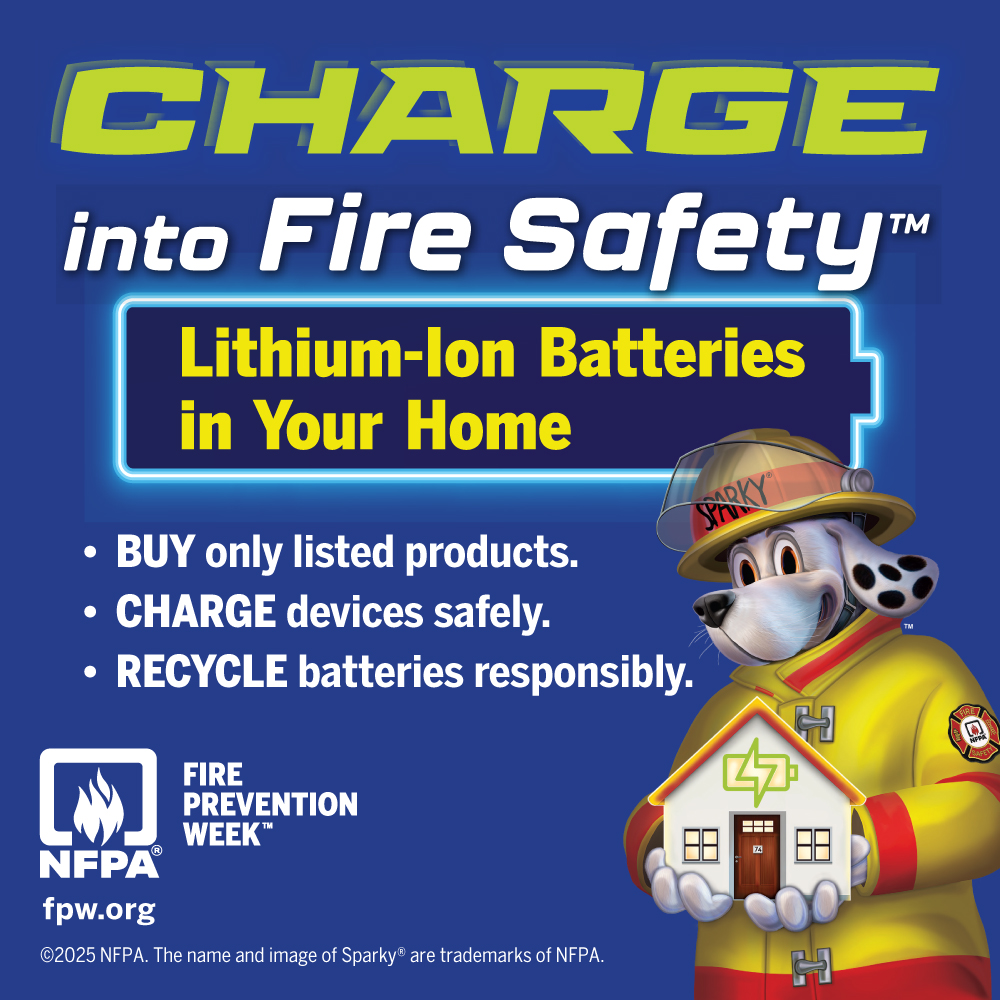
Fire Prevention Week Poster with cartoon image of Sparky the dalmatian dog mascot

Contact Us

City of Niagara Falls Fire Department
5809 Morrison Street
Niagara Falls, ON  L2E 2E8
Canada
905-356-7521
Fire Services Contact Form
Email Fire Services