Draft Plan of Subdivisions and Condominiums

A Draft Plan of Subdivision is a detailed proposal that shows how a piece of land will be divided and developed. It includes plans for lots, streets, parks, and public spaces. The city reviews and approves the draft to make sure the development is safe, organized, and meets the community's needs.

Condominiums (or "condos") come in different types, and the differences are mainly about what parts of the property you own individually and what parts are shared with others. A Plan of Condominium is processed similarly to a Plan of Subdivision.


Subdivision Control helps regulate how land is divided to ensure thoughtful and safe development. It follows rules in Section 50(3) of the Planning Act to protect health, safety, convenience, and accessibility while considering the needs of current and future residents.

When dividing land, one method is through a Plan of Subdivision.

What is a Plan of Subdivision?

A Plan of Subdivision is a detailed legal survey that shows:

  • The exact size and boundaries of new lots or blocks for homes or buildings
  • The location and width of public streets
  • The location of schools, parks, and public facilities

How does it work?

To create a Plan of Subdivision, landowners must first apply for a Draft Plan of Subdivision. This draft must be reviewed and approved by City Council.

The approval process ensures the development is well-organized and considers:

  • Necessary infrastructure and public services like roads and utilities
  • Recreational facilities for the community
  • The impact on nearby neighbourhoods
A Plan of Condominium is required when a property is being divided into individual ownership units and shared common areas (Vacant Land Condominium, Common Element, Standard and Parcels of Tied Land) under the Condominium Act. This plan is needed to legally establish the condo corporation and define ownership rights.

You need to apply for a Draft Plan of Subdivision if you plan to divide your land into more than two new lots.

In some situations, Consent might be a better option, such as:

  • The subject lands front onto an existing and open public road that is constructed to municipal standards
  • The development is considered infilling
  • The proponent pays all fees generally related to the requirements of a Plan of Subdivision

Contact a City Planner to confirm which approvals you need to subdivide your land. 

Step 1: Pre-consultation

It is recommended that you attend a pre-consultation meeting before applying. Visit the pre-consultation webpage or contact a City Planner for details.

Step 2: Submit your application

Apply online through your City Dashboard Account and include:

  • Completed application form (available through your dashboard account)
  • A valid pre-consultation form or checklist
  • Signed draft plan of subdivision, in metric and prepared by an Ontario Land Surveyor
  • The property deed
  • Photo evidence of subdivision sign posted on the subject property in accordance with the City’s Public Notice Sign Policy (see the application form for more information)
  • Supporting studies, plans, information, and materials listed in the pre-consultation checklist
  • All required fees:

Draft plan of subdivision

Information to be shown on plans

Section 51(17) of the Planning Act requires that plans show the following information, as appropriate:

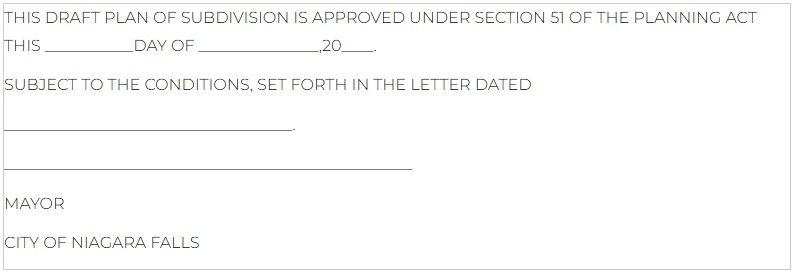
Draft approval certificate

Include the Draft Approval Certificate on each plan submitted at the time of application:

Ownership information and O.L.S. signature

  • Name of the registered owner, signature and date signed
  • Name of Ontario Land Surveyor, signature and date signed

Purpose and use of the lots

  • The purpose for which the proposed lots are to be used
  • Existing uses of all adjoining lands

Legal description and property details

  • Legal address and legal description of the property
  • Boundaries of the land proposed to be subdivided, certified by an Ontario Land Surveyor
  • Locations, widths and names of the proposed highways within the proposed subdivision and of existing highways on which the proposed subdivision abuts, including proposal reserves
  • Approximate dimensions and layout of proposed lots
  • Natural and artificial features, including municipal appurtenances, such as buildings or other structures or installations, railways, highways, watercourses, drainage ditches, wetlands and wooded areas within or adjacent to the land proposed to be subdivided
  • The availability and nature of domestic water supplies
  • The nature and porosity of the soil
  • Existing contours or elevations as may be required to determine the grade of the highways and the drainage of the land proposed to be subdivided
  • The municipal services available or to be available to the land proposed to be subdivided
  • Nature and extent of any restrictions affecting the land proposed to be subdivided, including restrictive covenants or easements

Key plan

Use a small key plan at a scale of at least 1 centimetre to 100 meters to show:

  • All land next to the proposed subdivision that the applicant owns or has an interest in
  • Every subdivision bordering the proposed subdivision
  • How the boundaries of the proposed subdivision connect to the boundaries of the township lot or other original grant of which the land forms the whole or part

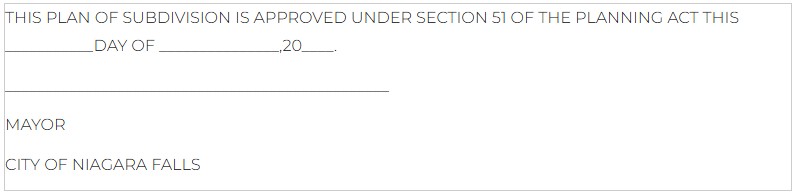
Final approval certificate

Include the Final Approval Certificate on each plan submitted for registration:

Draft plan of condominium

Information to be shown on plans

Section 51(17) of the Planning Act requires that plans show the following information, as appropriate:

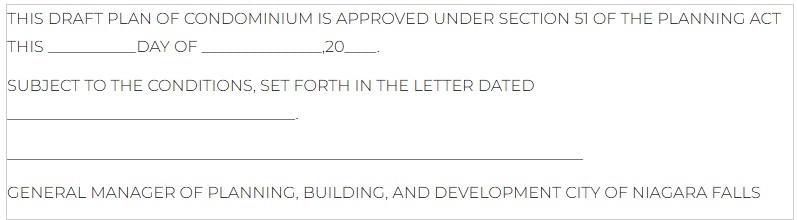
Draft approval certificate

Include the Draft Approval Certificate on each plan submitted at the time of application:

  • Location and number of units to be sold, on a floor-by-floor basis
  • All common elements (i.e., corridors, lobbies, elevators, etc.)
  • Location and number of parking spaces, if they are to be sold separately
  • Location and amount of landscaped open space and common recreation space

Ownership information and O.L.S. signature

  • Name of registered owner, signature and date signed
  • Name of Ontario Land Surveyor, signature and date signed

Legal description and property details

  • Legal address of the property
  • Boundaries of the land proposed to be subdivided, certified by an Ontario Land Surveyor
  • Locations, widths and names of the proposed highways within the proposed subdivision and of existing highways on which the proposed subdivision abuts

Purpose and use of the lots and adjoining lands

  • The purpose for which the proposed lots are to be used
  • Existing uses of all adjoining lands
  • Approximate dimensions and layout of proposed lots
  • Natural and artificial features, including municipal appurtenances, such as buildings or other structures or installations, railways, highways, watercourses, drainage ditches, wetlands and wooded areas within or adjacent to the land proposed to be subdivided
  • Availability and nature of domestic water supplies
  • Nature and porosity of the soil
  • Existing contours or elevations as may be required to determine the grade of the highways and the drainage of the land proposed to be subdivided

Servicing information

  • Show the municipal services that are available or will be available for the land that is proposed to be subdivided
  • Explain any restrictions on the land, such as restrictive covenants or easements

Key plan

Use a small key plan at a scale of at least 1 centimetre to 100 meters to show:

  • All land next to the proposed subdivision that the applicant owns or has an interest in
  • Every subdivision bordering the proposed subdivision
  • How the boundaries of the proposed subdivision connect to the boundaries of the township lot or other original grant of which the land forms the whole or part

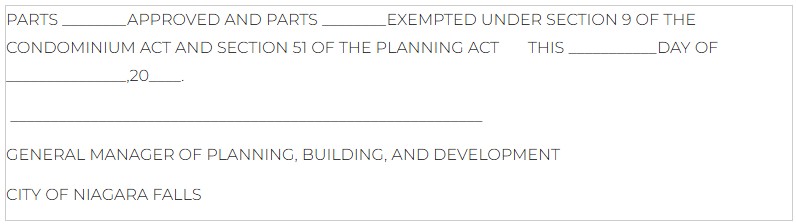
Final approval certificate

Include the Final Approval Certificate on each plan submitted for registration:

It is the responsibility of the applicant to post a Public Notice Sign(s) about the Draft Plan of Subdivision or Condominium being proposed. The sign must be installed following the City’s Public Notice Sign Policy, the Planning Act and any other City standards.

Draft Plan of Subdivision or Condominium Application

Time to process (to decision): 120 days

Step City's Role Applicants Role Target Timeline
Pre-Consultation

City Staff, any required agencies and an applicant will review a preliminary development proposal, discuss the nature of the proposal, any development and planning issues, the need for additional information, and the planning approvals process.

The City will provide the applicant a pre-consultation form/checklist identifying what approvals, studies, information, materials, and fees are required to proceed with a formal application. 

Applicant completes pre-consultation process 3 weeks
Application Submission-Step 1 N/A Applicant submits:
  • Formal application
  • Studies and draft plan
N/A
Application Submission-Step 2 Reviews files (i.e., names, unlocked status)  N/A 2 days
Application Submission-Step 3 N/A Applicant pays required fees 1 day
Application Submission-Step 4 Planner assigned to file N/A 1 day
Review for Completeness Planner reviews material and issues notice of complete/incomplete application. N/A 1 week
Circulation (When Complete) Planner circulates to internal departments and external agencies. Comments and draft plan conditions are consolidated and provided to Applicant. N/A 2 weeks
Open House Held to inform and receive comments from area residents. Applicant or their agent attends to present and answer questions. Occurs 2 weeks after notice is given to residents.
Public Meeting-Step 1 Held to inform and receive comments from area residents and Council. Applicant or their agent attends to present and answer questions. Occurs 30 days after notice is given in accordance with Council's schedule.
Public Meeting-Step 2 The recommendation report with draft plan conditions is on Council's agenda. Council will make a decision on the application. N/A N/A
Final Approval-Step 1 Notice of Decision given by Planner. N/A 1 week
Final Approval-Step 2 If no appeals, Declaration Notice given by Planner and Draft Plan signed by Mayor. N/A 20 days after Notice of Decision.

Draft Plan of Subdivision Application

Time to process: Varies (Draft plan approval: 3 years)

Step City's Role Applicants Role Target Timeline
Clearance of Conditions-Step 1

N/A

Submits 1st engineering submission to the City's Municipal Works department.

N/A
Clearance of Conditions-Step 2

City's Municipal Works department reviews and provides comments.

Municipal Works circulates the 1st engineering submission to the Niagara Region.

Applicant resubmits until Municipal Works accepts plans.

Once engineering plans accepted, Applicant provides cost estimates and Environmental Compliance Approval Form (if municipal services extended) to Municipal Works.

Municipal Works provides comments within 2 weeks.
Clearance of Conditions-Step 3 N/A Submits material to Planner:
  • Condition clearance chart
  • Draft 59M and 59R plans
  • Clearance letters from agencies who imposed draft plan conditions
  • Studies
N/A
Clearance of Conditions-Step 4 Planner circulates material to internal departments and Niagara Region (NPCA if applicable). N/A 2 weeks
Clearance of Conditions-Step 5 Planner notifies Applicant status of draft plan conditions. N/A N/A
Clearance of Conditions-Step 6 Planner circulates material to internal departments and/or Niagara Region that have outstanding conditions and provides comments. Applicant submits any outstanding items and/or clearance letters to Planner. 2 weeks
Pre-servicing-Step 1 N/A

May request Pre-servicing approval from Municipal Works.

Environmental Compliance Approval required.

N/A
Pre-servicing-Step 2 Municipal Works issues Pre-servicing/Road Occupancy Permits. N/A 2 weeks
Pre-servicing-Step 3 N/A Coordinates with Municipal Works for inspection, material testing, and site meetings. N/A
Final Approval-Step 1 Municipal Works prepares a draft Subdivision Agreement and provides it to the Planner. N/A 2 weeks
Final Approval-Step 2 Planner circulates to internal departments and agencies for review. N/A 1 week
Final Approval-Step 3 Once conditions are cleared, Planner notifies Legal Services. N/A 1 day
Final Approval-Step 4 Legal Services sends draft agreement to Applicant. Applicant notifies Legal Services of any revisions necessary. 1 day
Final Approval-Step 5 Legal Services sends the final agreement to the Applicant's Lawyer for execution and outlines the deliverables required. N/A 1 day
Final Approval-Step 6 N/A Applicant provides required material to Legal Services (i.e., securities, cash owing, PIN details, Solicitor’s Certificate, Certificate of Insurance, and draft legal documents. N/A
Final Approval-Step 7 Planner has Mayor sign Subdivision Plans and prepares Land Registry Office letter. N/A 1 day
Registration-Step 1 N/A Provides 2 copies of executed Subdivision Agreement and required documents to Legal Services. N/A
Registration-Step 2 Legal Services:
  • Provides Municipal Works with security, cash payments, and insurance documents.
  • Confirms with Planning that Plans may be deposited at the Registry Office.
  • Initiates registration of Subdivision Agreement and Inhibiting Orders, if required.
N/A 1 week
Registration-Step 3 Planner notifies Applicant Plans may be picked up and deposited at Registry Office. Applicant completes Land Registry process. 1 day
Building Permit Once satisfied with completion of Class 1 works, Municipal Works provides Building Permit Issuance Memo, plans, and reports to CBO. N/A N/A
Release of Security-Step 1 N/A Coordinates with Municipal Works for inspections, tests, provision of as-constructed plans, and certification of Class 2 works. N/A
Release of Security-Step 2 Release of Securities by Municipal Works in accordance with the Subdivision Agreement. N/A 2 weeks

How long do I have to meet the conditions for Draft Plan Approval?  

You have 3 years to meet the conditions of your Draft Plan Approval. If you don’t get Final Subdivision Approval within that time, the Draft Plan Approval will expire under Section 51(32) of the Planning Act. Before it lapses, you can request an extension under Section 51(33) of the Planning Act. Talk to a City Planner to learn about the submission process and fees.

Can I modify my approved Draft Plan of Subdivision?

Yes. You will need to meet with the City and required agencies to discuss the changes. During this pre-consultation, you’ll learn about the studies, plans, information, materials, and fees needed for your application. After that, your request will generally follow the standard Draft Plan of Subdivision process.

Contact Us

City of Niagara Falls
Planning and Building

4343 Morrison Street
P.O. Box 1023
Niagara Falls, Ontario L2E 6Z9
Canada
905-356-7521 ext. 4330
pbd@niagarafalls.ca